How Neural Networks Recalibrate In-Game Prop Markets for Niche Athletics on Transnational Wagering Platforms
Finley Carter · Jun 19, 2026

How Neural Networks Recalibrate In-Game Prop Markets for Niche Athletics on Transnational Wagering Platforms
Neural networks handle the continuous flow of data that drives adjustments in prop markets for niche athletics such as korfball, sepak takraw, and beach handball on platforms operating across multiple jurisdictions. These systems ingest inputs from sensors, video feeds, and historical performance records, then update odds in fractions of a second while matches unfold. Operators rely on the models to maintain balance between liquidity and risk exposure when bettors place wagers on specific events like a player’s successful serves or team possession percentages. Data aggregation begins with structured streams that include player biometrics, environmental conditions, and previous tournament results. The networks apply weighted layers to identify correlations that traditional statistical methods often miss, such as subtle shifts in fatigue patterns during extended rallies. Once patterns emerge, the system recalibrates line values for individual props without requiring manual intervention from traders.Real-Time Model Architecture
Recalibration occurs through recurrent and transformer-based architectures that maintain memory of recent sequences while incorporating new observations. A serve in sepak takraw, for instance, triggers an immediate evaluation of trajectory data against thousands of comparable attempts stored in the model’s training set. The output adjusts the implied probability for that prop and propagates the change across correlated markets like total points in the current set.
Transnational platforms must accommodate differing regulatory thresholds for maximum stake sizes and market suspension rules. The same neural network therefore contains jurisdiction-specific constraint layers that limit exposure in certain regions while allowing deeper liquidity elsewhere. These layers activate automatically based on geolocation signals and account verification status.
Inputs Specific to Niche Athletics
Niche sports generate smaller overall data volumes than mainstream football or tennis, so networks supplement live feeds with synthetic data generated from simulations of rule variations and venue conditions. Researchers have noted that models trained on augmented datasets maintain lower variance in odds accuracy during low-traffic events. In June 2026 several platforms reported integration of additional motion-capture metrics from portable athlete wearables that further refined prop valuations for lesser-followed disciplines.
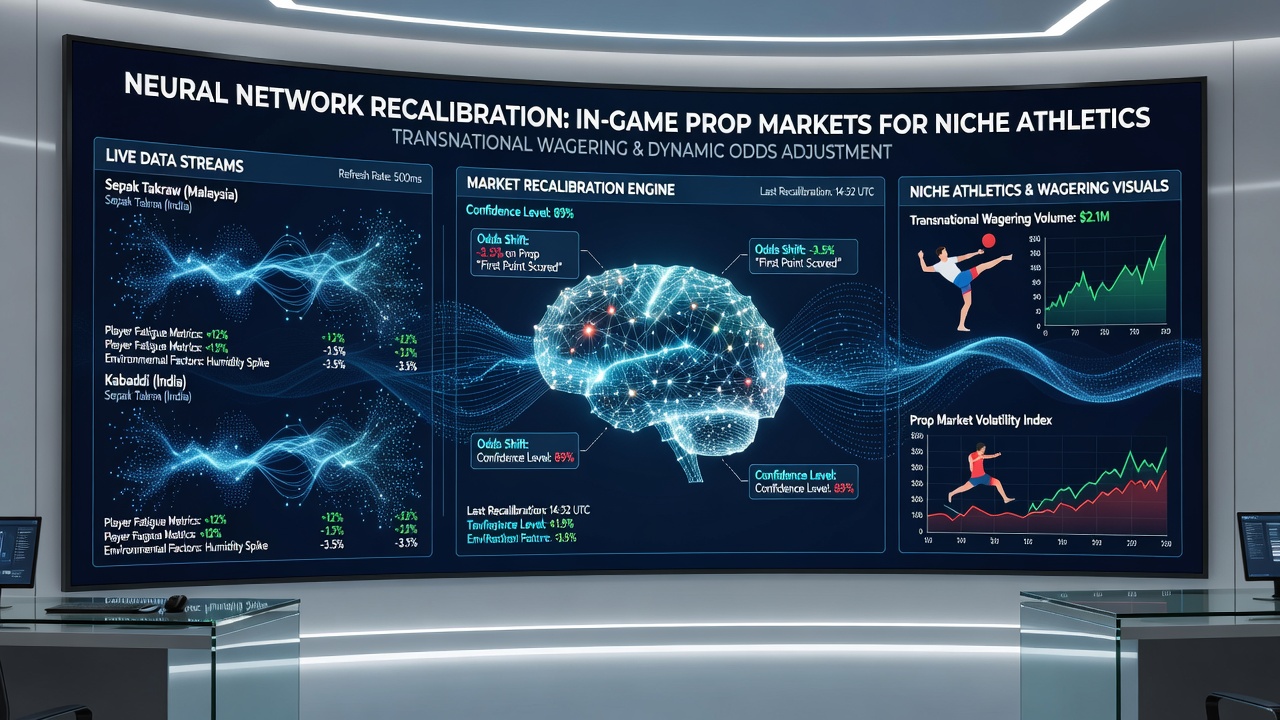
Environmental factors such as wind speed at outdoor venues or court surface temperature enter the feature set directly. The network assigns dynamic importance weights to these variables because their influence on outcomes proves stronger in sports with smaller margins of error. When a sudden gust alters ball flight in beach handball, the model updates the probability distribution for next-point props within the same rally.
Cross-Border Data Governance
Platforms coordinate model updates through centralized training clusters while deploying inference endpoints closer to regional users to reduce latency. Compliance teams reference guidelines from the European Gaming Regulators Forum and the Victorian Responsible Gambling Foundation to ensure recalibration logic respects local responsible-gambling thresholds. These constraints appear as hard caps within the loss-function during training so the network never proposes market states that violate jurisdictional limits.
Security protocols encrypt both incoming sensor streams and outgoing odds feeds. Audit logs capture every weight adjustment and the timestamped data that prompted it, allowing regulators to reconstruct how a particular prop line moved during a match. Observers note that this traceability has become standard for operators seeking licenses in multiple markets simultaneously.
Performance Metrics and Validation
Validation occurs through back-testing against archived matches and forward-testing in shadow mode before live deployment. Accuracy metrics focus on calibration error rather than raw prediction success because the goal is balanced market pricing rather than directional forecasting. When calibration drift exceeds predefined tolerances the system triggers a full retraining cycle using the most recent event data.
Operators have documented cases where neural recalibration reduced the frequency of manual interventions by more than half compared with earlier rule-based systems. The improvement appears most pronounced in markets with sparse historical records, precisely the niche athletics segment that once required heavier human oversight.
Conclusion
Neural networks now form the core mechanism through which transnational platforms maintain dynamic, data-driven prop markets for niche athletic events. Continuous ingestion of live and historical inputs, combined with jurisdiction-aware constraint layers, allows recalibration that keeps odds aligned with emerging match conditions. As sensor technology and model sophistication advance, the same frameworks are expected to extend coverage to additional emerging disciplines while preserving compliance across regulatory environments.